If you own a home, chances are your yard is not flat. Many properties sit on slopes, hills, or uneven ground. Because of that, a lot of homeowners think about building a retaining wall. It can stop soil from sliding, create level space, and make your yard safer. However, here’s the problem. Many people jump straight into building without really understanding how their land works. As a result, they run into drainage issues, permit delays, or even wall failure. That’s where a topographic survey becomes so important. It gives you a clear picture of the land, including how your land’s slope and elevation are measured, so you’re not making decisions based on guesswork.
Atlanta Yards Are Not As Simple As They Look
At first glance, your yard may seem easy to work with. It might just look like a small slope or a slight hill. But in reality, the ground in Atlanta can be tricky.
For example, many areas have clay-heavy soil. This type of soil holds water. So, when it rains, water does not drain quickly. Instead, it builds pressure under the surface.
At the same time, slopes in Atlanta are often uneven. One part of your yard may drop faster than another. Because of that, water flows in ways you may not expect.
So, even if your yard looks simple, the land may behave very differently once construction starts.
Where Retaining Wall Projects Usually Go Wrong
Many homeowners make the same mistake. They look at the slope, take a quick guess, and move forward with building. At first, everything seemed fine.
But once the work begins, small issues start to show. The wall might not sit where it should, or it ends up closer to the property line than expected. Sometimes the height is based on what the slope looks like, not what it really is.
Then it rains. Water doesn’t follow the path you had in mind. It finds its own way, and that’s usually when things go wrong. It’s easy to overlook how water moves through your yard until it starts pushing toward the wall instead of away from it. Over time, that pressure can lead to cracks or even failure.
In the end, the problem isn’t the wall. It’s starting the project without really understanding the land.
How a Topographic Survey Helps You Make Better Decisions
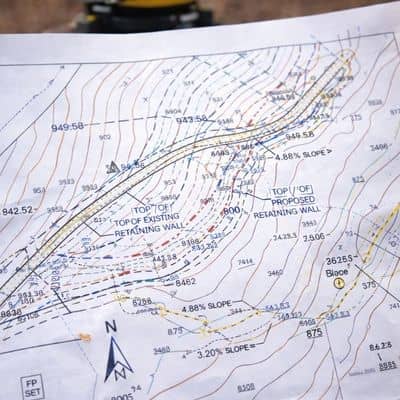
This is where a topographic survey comes in.
A topographic survey maps the shape of your land. It shows elevation changes, slopes, and how water moves across your property. Instead of guessing, you get clear and accurate data.
Because of that, you can make smarter decisions before construction begins.
For example, you can find the safest place to build the wall. You can also understand how tall the wall should be. In addition, you can see how the slope will affect the structure.
Most importantly, engineers and contractors rely on this data. It helps them design a wall that fits your land, not just your idea.
The Hidden Problem: Water Pressure Behind the Wall
Now let’s talk about one of the biggest issues with retaining walls—water.
When it rains, water moves downhill. That sounds simple, but it’s not always easy to predict. Water may collect in certain spots or flow faster in others.
Without a topographic survey, you won’t know where that water is coming from.
As a result, water can build up behind your retaining wall. This creates pressure. Over time, that pressure pushes against the wall.
Eventually, the wall may start to lean, crack, or fail.
However, with the right data, you can plan for this. You can add proper drainage. You can guide water away from the wall. So instead of reacting to problems later, you prevent them from the start.
Why Permits in Atlanta Can Slow You Down
Building a retaining wall in Atlanta often requires permits, especially if the wall is tall or affects drainage.
Now here’s where many projects get stuck.
If your plans do not match the actual land conditions, the city may ask for changes. This leads to delays. In some cases, you may need to redesign the wall completely.
That means more time, more stress, and more cost.
On the other hand, a topographic survey gives you accurate site data from the beginning. Because of that, your plans are more likely to match what the city expects.
So instead of going back and forth, you move forward with confidence.
When You Should Not Skip a Topographic Survey
You might be wondering if you really need a survey. In some cases, it may not be required. However, there are situations where skipping it is risky.
For example:
- If your yard has a noticeable slope
- If the wall will hold back soil or support a structure
- If the wall is near a property line
- If the project is part of a bigger upgrade
If any of these apply to your property, it’s best to start with a topographic survey.
Guessing the Slope Can Cost You More Than You Think
It’s easy to think you can save money by skipping the survey. After all, it may seem like an extra step.
However, guessing the slope often leads to bigger costs later.
For instance, you may need to rebuild part of the wall. You might have to fix drainage problems. In some cases, you may even face damage to nearby structures.
All of these issues cost more than getting accurate data upfront.
So, while a topographic survey has a cost, it actually helps you avoid much larger expenses.
Start With the Land, Not the Wall
At the end of the day, a retaining wall is only as strong as the ground it sits on.
If you don’t understand your land, you are building on guesswork. But when you start with a topographic survey, you gain clarity.
You see how your land really behaves. You understand where problems may happen. And most importantly, you can plan the right solution from the beginning.
So, if you’re thinking about building a retaining wall, take a step back first.
Start with the land. Then build with confidence.